An IGNOU Synopsis is the research plan you send for approval before your project or dissertation begins. IGNOU has no single rule for it: each course's guideline names its own desk, papers and wait. MBA (MMPP-001), BBA (BMPP-001) and MCA_NEW (MCSP-232) proposals go to your Regional Director; the MLIS synopsis goes to the Programme Coordinator at SOSS; MAMIDI proposals go to SOITS by email or post. Most courses want a proforma signed by you and your guide, plus the guide's bio-data. Any other course follows its own guideline.
- The project upload portal is for reports. IGNOU's June 2026 upload page told candidates not to upload a synopsis there and said the proposal is forwarded to the concerned School or Regional Centre.
- The approved papers travel twice. The same upload page asks for the approved proforma in original, with the synopsis and the guide's bio-data, inside the final report file wherever applicable.
- The desks really differ. MCSP-232 says never to send the proposal to SOCIS; the MLIS synopsis goes to SOSS at Maidan Garhi; MMPP-001 and BMPP-001 go to your Regional Director.
- Objectives must not assume the answer. MMPP-001 and BMPP-001 both ask for objectives written in a neutral manner, without assumptions about the findings.
- The guide is judged on the same form. The BMPP-001 and MECP-201 proformas each carry a separate Approved or Not Approved box for the supervisor.
- Some documents disagree with themselves. The MCSP-232 guidelines print two page ranges for the synopsis and three different approval times.
IGNOU Synopsis: the plan IGNOU approves before your project starts
The IGNOU Synopsis is a short research plan: what you will study, why, and how. In most IGNOU project courses nothing else can begin until an evaluator has read it, marked it Approved and the letter has reached you. The BBA guidelines put it plainly: only after approval of the synopsis can the project work be taken up.
It is not a mini report. It carries no findings, because you have collected no data yet. It promises a method and asks permission to use it. That is why IGNOU judges your guide at the same moment: the proforma that travels with the synopsis asks who will supervise you and whether that person meets the course's rules.
Students who arrive here from a search for an IGNOU project usually need this stage first. The project report, the binding and the upload come later, and each depends on the approval letter you get now.
One paper, four names, seven deciders
IGNOU documents rarely say synopsis alone. The same paper is called a project proposal, a project synopsis, a dissertation proposal or a research project proposal, depending on the School that wrote the course. The name matters less than the desk that decides it, and that desk is the column students most often get wrong.
| Course | What its document calls it | Who decides |
|---|---|---|
| MMPP-001 (MBA) | Project proposal, sent with the Proforma for Approval of Project Proposal | An evaluator at the Regional Centre |
| BMPP-001 (BBA) | Project synopsis, with the Proforma for Approval of Project Proposal (BMPP-001) | An evaluator, counter-signed by the Regional Director or Assistant Regional Director |
| MCSP-232 (MCA_NEW) | Project proposal with a synopsis of the project | The Regional Centre, after evaluation |
| MLIP-002 (MLIS) | Synopsis (the guide calls it proposal and synopsis) | The MLIS Programme Coordinator, SOSS |
| MDIP 001 (MAMIDI, PGDMIDI) | Research project proposal, with the Approval of Research Project form | The programme at SOITS |
| MESP-001 (MAEDU) | Dissertation proposal, with its proforma | The Regional Centre (RC Delhi-3 notice) |
| MECP-201 (MA Economics) | Project proposal, with Annexure A | The Economics Faculty, School of Social Sciences |
Built from each course's own guideline or form, read in October 2026.
Course missing from this table? Two places on your own course's proforma answer both columns: its title gives the name of the paper, and its office-use box shows who signs the decision. Both forms read box by box further down are laid out that way.
IGNOU में सिनॉप्सिस वह शोध योजना है जिसे प्रोजेक्ट शुरू करने से पहले मंज़ूरी के लिए भेजा जाता है। हर कोर्स की गाइडलाइन अलग पता बताती है: MBA (MMPP-001) और BBA (BMPP-001) में यह आपके रीजनल डायरेक्टर को जाती है, जबकि MLIS (MLIP-002) में SOSS के प्रोग्राम कोऑर्डिनेटर को; बाकी कोर्स में अपनी गाइडलाइन में छपा पता ही मानें। ज़्यादातर कोर्स में आपके और गाइड के हस्ताक्षर वाला प्रोफ़ॉर्मा और गाइड का बायो-डेटा साथ भेजना होता है। MMPP-001 और BMPP-001 में मंज़ूरी में दो से तीन महीने लिखे हैं। सिनॉप्सिस को SED के प्रोजेक्ट अपलोड पोर्टल पर अपलोड नहीं करना है।
Where an IGNOU Synopsis goes: seven courses, five routes
An IGNOU Synopsis posted to the wrong desk costs you time, because it has to be returned or forwarded before anyone can read it. IGNOU's June 2026 upload page gives only the general rule: the proposal is forwarded to the concerned School or Regional Centre. Your course's guideline says which one.
Synopsis route and packet finder
Built from the MMPP-001, BMPP-001 and MCSP-232 guidelines, the MLIS Programme Guide, the MDIP 001 Project Manual, RC Delhi-3's proposal notice and the MECP-201 Annexure A form, read in October 2026.
This finder needs JavaScript. The table below gives the same answers for the seven courses, and the note under it covers every other course.
The finder prints only what the named document says for that course, with the document and the month we read it. When a document is silent (approval time for MLIP-002, length for MMPP-001), the finder says so rather than filling the gap. MESP-001 and MECP-201 rows rest on a Regional Centre notice and on the printed form, so they name those sources.
| Course | Desk | What travels with it | Approval time printed |
|---|---|---|---|
| MMPP-001 | Regional Director of your own Regional Centre; MMPP-001 on the envelope | Signed proforma, one copy of the proposal, guide's signed bio-data | Two to three months |
| BMPP-001 | Regional Director of your respective or designated Regional Centre; BMPP-001 on the envelope; LMS soft copy for online students | Proforma signed and dated by you and your guide, guide's signed bio-data | Two to three months |
| MCSP-232 | Regional Director of your Regional Centre, April to June or October to December slot; never SOCIS | Proforma, guide's signed bio-data with a certified ID proof, synopsis, stamped self-addressed envelope | 30 days, four to six weeks, or six to eight weeks (printed three ways) |
| MLIP-002 | Programme Coordinator, MLIS, SOSS, Maidan Garhi; or by email to ignnoulis@gmail.com, not both | Synopsis, guide's signed bio-data | Not printed |
| MDIP 001 | pgdmidi@ignou.ac.in, or Dr. Sadananda Sahoo, SOITS, Block 15, Maidan Garhi | Proposal of 1,200 to 1,500 words, Approval of Research Project form | Not printed |
| MESP-001 | Your Regional Centre, as RC Delhi-3's 2020 notice describes; that notice used an email route | Cover page, proforma signed and dated by you and your guide | Not printed |
| MECP-201 | The School: Proposal No. assigned by the School, decision signed by the Economics Faculty | Annexure A, project proposal, supervisor's signed bio-data | Not printed |
The same rules as the finder, for reading without JavaScript.
Not one of these seven? In the finder, choose My course is not in this list and type your course code. It lists what to look for in your own course document and links our course page if this site has one. Without JavaScript, open your course's project guideline and find the submission address first; everything else in the packet follows from it.
The guide signs before anything travels
Every IGNOU Synopsis in our finder, except the MDIP 001 proposal, travels with the guide's signature or bio-data, so the guide has to be settled first. The rules for who may guide are course rules, and they are strict.
| Course | Who may guide (as printed) | Ceiling |
|---|---|---|
| MMPP-001 | SOMS management faculty at headquarters; approved academic counsellors; management faculty with five years of PG teaching; qualified professionals with five years' relevant experience | Five students at any time |
| BMPP-001 | SOMS commerce and management faculty; approved counsellors of BBA, B.Com., M.Com. and MBA with five years' teaching or counselling; commerce or management faculty with five years of UG or PG teaching; CA, CS, ICWA or engineers with five years' experience; M.Com or MBA holders with five years' professional experience | Five students at any time |
| MCSP-232 | PhD or M.Tech in Computer Science with one year's experience; or B.E. or B.Tech (Computer Science), MCA or M.Sc. (Computer Science) with two years, preferably in software development | Five MCA students at any time |
| MLIP-002 | PhD in Library and Information Science, or a master's in LIS with library, information-centre or teaching work, at Assistant Professor scale or Pay Level 10 | Not printed in the 2022 guide |
From the MMPP-001, BMPP-001 and MCSP-232 guidelines and the MLIS Programme Guide, read 21 October 2026.
Your course is not among these four? Its guide rule sits in the same document as its proforma, under a heading on the supervisor or guide. Read it before your guide signs anything, because the proforma asks for details that are checked against that rule.
On the BMPP-001 and MECP-201 forms you also state whether your supervisor is an IGNOU academic counsellor and how many students that person already guides. An evaluator can approve your synopsis and still refuse your supervisor; the two boxes are separate.
Two proformas, read box by box
The proforma is the cover sheet that decides whether your IGNOU Synopsis is even read. We have put two side by side because they show something most students never notice: the same kind of form is decided at a Regional Centre for a School of Management Studies course, and at the School itself for MECP-201.
| Box | BMPP-001 proforma (School of Management Studies) | MECP-201 Annexure A (School of Social Sciences) |
|---|---|---|
| Proposal number | Project Proposal No., to be assigned by the Regional Centre. Leave it blank. | Project Proposal No., to be assigned by the School. Leave it blank. |
| Enrolment, study centre, regional centre | You fill. Use the enrolment number on your ID card. | You fill, with Study Centre Code and Regional Centre Code. |
| Subject area | You tick one: HRM and OB, Accounting and Finance, Operations Management and Information System, Marketing, Corporate Management, Any Other. | Not on this form. |
| Name and address | You fill. The address is where the synopsis decision is sent, so give the full postal address. | You fill name and address. |
| Email and mobile | Email address asked. | Both marked with a star; the form says it is mandatory to provide them. |
| Topic or title | Topic of the Project. Must match your synopsis word for word. | Title of the Project. Same rule. |
| Supervisor | Name and address of the supervisor; whether an academic counsellor of the Management Programme, and the study centre code if yes; courses counselled. | Name of the supervisor; whether an academic counsellor of MA (Economics); study centre if yes. |
| Students already guided | Number of students being guided for the project course on that date. | Number currently working under the supervisor for MECP-201 and MECP-202. |
| Signatures and dates | Student and supervisor, each dated. | Student and supervisor, each dated. |
| Enclosure reminder | Enclose the synopsis and the bio-data of the supervisor. | Enclose the project proposal and the signed bio-data of the project supervisor. |
| Office use | Evaluator's signature, date and comments; Synopsis and Supervisor each Approved or Not Approved; counter-signature of the Regional Director or Assistant Regional Director. | Proposal and Supervisor each Approved or Not Approved; signature of the Economics Faculty; date; comments if not approved. |
BMPP-001 boxes from the BBA Project Guidelines; MECP-201 boxes from the printed Annexure A of an approved copy, seen in October 2026.
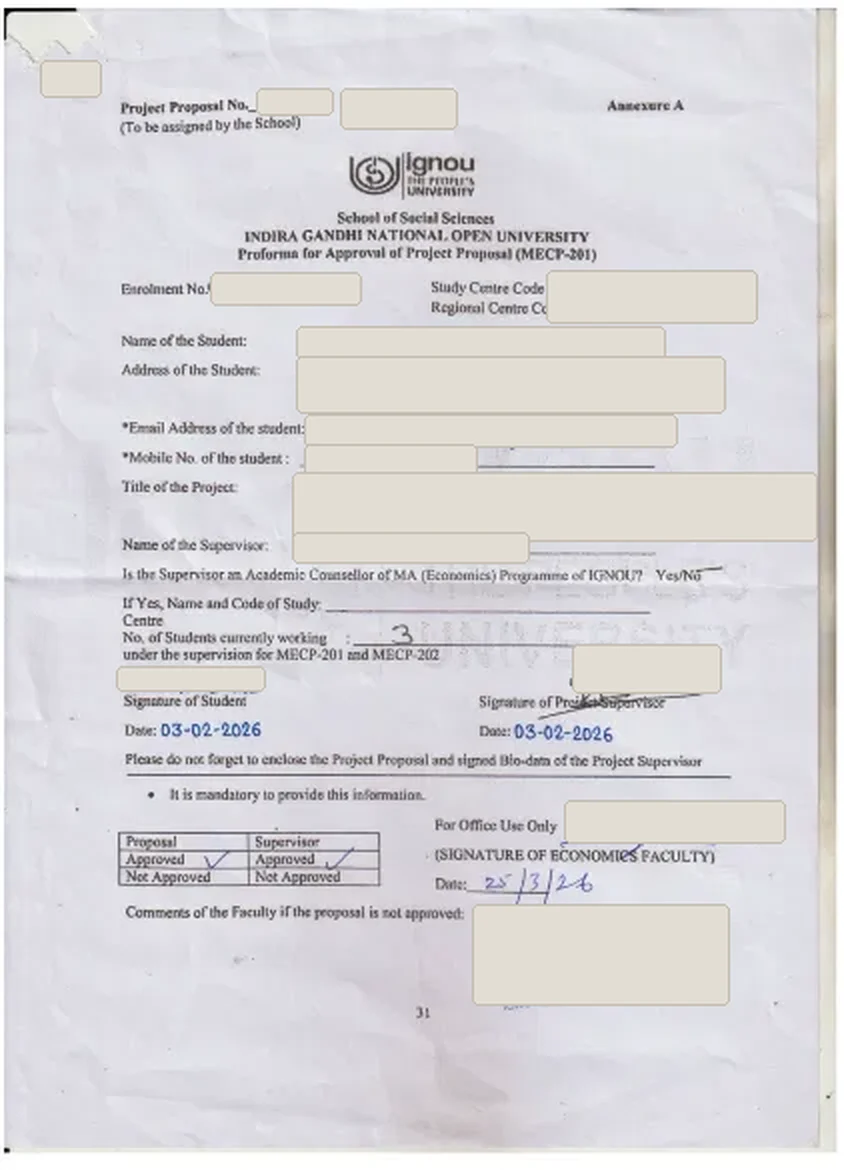
Studying a different course? Do not borrow either of these forms. Fill the proforma printed in your own course's guideline and use the rows above as a checklist, since the same kinds of box recur on both forms: a number you leave blank, a title that must match the synopsis, the supervisor's details and two dated signatures.
Have the whole synopsis packet read before it is posted
Most returned synopses fail on things a careful second reader would have caught: a missing part, an objective that assumes its answer, an unsigned box. Our desk reads the synopsis and proforma you wrote against your own course's guideline and sends them back with every change marked. You stay the author, and IGNOU's evaluator decides approval.
In a synopsis packet we read for
- Every part your guideline names, in its order (seven for BMPP-001, five for MMPP-001)
- Objectives in neutral wording, with no assumed findings
- Proforma boxes filled, signed and dated by you and your guide
- Guide eligibility against your course's list, and bio-data that is signed
- The desk and envelope marking your course asks for
In a report file we read for
- The approved title, word for word
- Approved proposal, proforma and bio-data bound in, not stapled
- Originality certificate signed and dated by you and your guide
- Page order, numbering and references in one consistent style
Synopsis correction Rs 1,000. Report correction Rs 2,000.
Ask for a synopsis correctionWe correct your own draft; we never sign for a guide or submit for you. Approval is decided by IGNOU's evaluator at the School or Regional Centre, never by us.
What goes inside, course by course
The parts of an IGNOU Synopsis are set by your course, and the lists differ more than students expect. BBA wants implications; MMPP-001 does not name them. MCA_NEW wants a database design and a security section. MAMIDI caps the whole proposal at 1,500 words.
Where the IGNOU synopsis guidelines differ, part by part
| Course | Parts printed | Length |
|---|---|---|
| MMPP-001 | Introduction, rationale, objectives, research methodology, limitations | Not set |
| BMPP-001 | Introduction, rationale, literature review, objectives, research methodology, implications, limitations | Not set |
| MCSP-232 | Title, introduction and objectives, project category, tools and platform, requirements, scope, analysis models, database design, module structure, network architecture where needed, security, future scope, bibliography | 14 to 18 pages (section I) or 15 to 20 pages (section V) |
| MDIP 001 | Title page, topic statement, aims and objectives, literature review, study design, research methods, tentative chapter outline (optional), references | 1,200 to 1,500 words with references |
| MLIP-002 | Not listed in the 2022 Programme Guide | Not set |
From each course's own document, read 21 October 2026.
For a course outside this table, the list of parts is in its own project guideline. Where the guideline gives none, the five MMPP-001 parts make a reasonable frame to agree with your guide, but only as a frame: your course's document, if it prints a list, always wins.
Two rules repeat across the management courses. Objectives must be neutral, so write "to study the relationship between" rather than "to prove that". And the methodology has to explain each choice: design, data source, sample and its rationale, tools and their link to each objective. For the layout of the document itself, including front pages, the synopsis format and front-page guide on ignouproject.com covers it, and our page on writing each part step by step walks through drafting.
Free sample synopsis and report template
The IGNOU synopsis sample PDF below follows the seven BMPP-001 parts on a fresh topic, seller adoption of ONDC among small retailers. Every place, figure and empirical study is left in square brackets for your own work, and the file is watermarked as study reference. The second file is a BMPP-001 report template: page order, a methodology checklist and empty table shells, with no findings.
Sample synopsis, BMPP-001 (BBA)
Seven parts, neutral objectives, null hypotheses, a methodology table and APA references. 7 pages.
Download the sample synopsis (PDF)Report format template, BMPP-001
Page order with the source of each rule, Chapter 3 checklist, table shells and a posting checklist. 5 pages.
Download the report template (PDF)On another course? Read the sample for how each part ties back to the objectives, then rebuild your draft under the headings your own guideline prints. The seven headings in this file are BBA's, and the template's page order is the BMPP-001 order.
- Common Prospectus, July 2026 (fees, p. 27)
- MMPP-001 Project Guidelines, School of Management Studies
- BBA Project Guidelines, BMPP-001, with its proforma
- MCSP-232 Project Guidelines, MCA_NEW
- MLIS Programme Guide, July 2022
- MDIP 001 Project Manual, SOITS
- Online project submission page, June 2026, SED
- Sample synopsis, BMPP-001 (ONDC topic), watermarked
- Report format template, BMPP-001, empty shells only
- Research methodology guide for MMPP-001 projects, Zenodo, CC BY 4.0
- Research methodology guide for MCOP-001 projects, Zenodo, CC BY 4.0
When to post it: no single IGNOU synopsis submission last date
There is no IGNOU synopsis submission last date that covers every course. Apart from one old Regional Centre notice (RC Delhi-3 named 30 June for 2020), none of the documents read for this page prints a synopsis last date. What exists instead is a set of clocks. MMPP-001 says the Regional Centre is not responsible for timely disposal of a proposal received more than six months after you registered for the course. MCSP-232 prints two slots, April to June and October to December. BMPP-001 tells students to start the synopsis from the fourth semester onwards. And the approval itself takes time: two to three months in MMPP-001 and BMPP-001.
Approval clock and result window planner
An estimate. IGNOU prints approval periods for some courses and none for others; the writing months are yours to set, and the arithmetic is shown below the planner.
This planner needs JavaScript. The paragraph below shows the same arithmetic.
The planner adds the approval period to your posting month to give a letter window, then adds your writing months to the later end of that window. For MMPP-001 and BMPP-001 it reads the result windows those guidelines print: a report submitted from 1 December to 31 May falls in the window for the June term-end examinations, and one submitted from 1 June to 30 November in the window for December. For other courses it names the next term-end cycle only; SED publishes the upload last date for each cycle in its own notice (the June 2026 page closed on 15 June 2026).
If your course is not in the planner's list, choose My course is not in this list. The planner then assumes one to three months for the letter and names the next term-end cycle; replace that guess with the period your own guideline prints, where it prints one.
Waiting for the letter: approval and IGNOU synopsis status
IGNOU synopsis approval comes back in writing. MMPP-001 and BMPP-001 say the decision is sent within two to three months of the proposal reaching the Regional Centre, with a Project Proposal (PP) number that you will quote later. MCSP-232 prints shorter and conflicting periods. For MLIP-002, MDIP 001 and MESP-001 the documents we read print no period at all.
Your IGNOU synopsis status is held by the desk that received it, so that is where you follow up: the Regional Centre for MMPP-001, BMPP-001 and MCSP-232, the MLIS Programme Coordinator for MLIP-002, and the SOITS programme for MDIP 001. Keep your postal receipt or email copy; it is the only proof of the date the clock started. For checking a report after submission, use the project status steps explained on ignouproject.com; for what happens between posting and the letter, see how the approval process runs.
On a course not named here, the office your own guideline told you to post to holds the status. Write to it with your enrolment number, course code and posting date, and keep a copy of what you send.
Not approved: what to send back
A Not Approved mark on an IGNOU Synopsis is not the end of the course; it is a list of changes. The documents that describe resubmission all ask for the old papers back, so never throw away the returned set.
| Course | Resubmission packet (as printed) |
|---|---|
| MMPP-001 | Revised proposal, fresh proforma, copy of the rejected proposal and proforma with the evaluator's comments, PP number |
| BMPP-001 | Revised synopsis, fresh proforma, copy of the rejected synopsis bearing the evaluator's comments, PP number; a changed guide means a new proposal |
| MCSP-232 | Revised synopsis in the next slot, new proforma, the earlier synopsis and the non-approved proforma; a change of topic, software or guide needs a fresh proposal |
| MLIP-002, MDIP 001, MESP-001, MECP-201 | Not set out in the documents read; revise from the written comments and ask the same desk |
From the MMPP-001, BMPP-001 and MCSP-232 guidelines, read 21 October 2026.
Any other course: ask the desk that marked it Not Approved what to send back, in writing. Until it answers, assume it wants what these three courses want, the rejected copy with the evaluator's comments alongside the revised one.
From approved synopsis to the bound IGNOU project report
An approved IGNOU Synopsis does not stay behind. IGNOU's June 2026 upload page asks for the approved proforma in original, with the synopsis and the guide's bio-data, inside the project report file wherever applicable, plus the originality certificate signed and dated by student and guide. The BBA guidelines say the approved proposal, proforma and bio-data must be properly bound in, not stapled, and the report must carry the title the evaluator approved.
Not on BBA? The upload-page rule above was written for project reports submitted on that portal; how the approved papers are bound in, and in what order, comes from your own course guideline.
When an IGNOU project synopsis becomes chapter one
Students who search for an IGNOU project report are usually at this point. The objectives in your approved synopsis become the spine of the report: the methodology chapter restates them, the analysis chapter answers each one, and the evaluator compares the two. A report that quietly changes its objectives invites the question of whether it is the project that was approved.
Services and prices at our synopsis desk
Our desk reads each IGNOU Synopsis against the guideline of the course it was written for. ignousynopsis.in is run by the same company, team and price list as ignouproject.com. Send your programme code, course code and stage on WhatsApp; every quote is confirmed in writing before you pay, and hard copies go by Delhivery speed post to your address.
Synopsis correction
Rs 1,000
Your synopsis and proforma read against your course's own guideline and returned with every change marked.
Report correction
Rs 2,000
Your report, certificate and bound papers checked against your guideline, chapter by chapter.
Topic and methodology
Quoted on WhatsApp
A topic your course and your access to data can support, and a design that fits your objectives.
Literature and questionnaire support
Quoted on WhatsApp
Finding relevant studies, and matching your questionnaire items to your objectives.
Data analysis help
Quoted on WhatsApp
Choosing the right test for each objective and reading the output of the data you collected.
Formatting, printing and binding
Quoted by page count
Page order, printing and hard binding at our own press in Dwarka.
Help books
Rs 249 hard copy, Rs 99 soft copy
Course-wise help books to read beside the free official blocks on eGyanKosh, priced per book.
Guess papers and solved question papers
Rs 49 PDF, Rs 100 printed
Revision sets built from past term-end papers, with reference answers, per subject. They do not predict the paper.
Guides, tools and sample files
Free
Both tools on this page, the course pages further down and the two sample files, with no sign-in.
Prices as on ignouproject.com, 28 September 2026. IGNOU's own project evaluation fee, Rs 300 up to 4 credits and Rs 500 above, is paid to the University with the term-end examination form, never to us.

 BK Sahni
 Anjali Sharma
 Kriti Arora
 Deepshikha
 Irfan Ahmad